Fork scratches
- Cause
- Forks come in high, low, or tilted back and drag across the sheet below.
- Effect
- Scratched material, usually scrapped, and parts your customer can reject.

JODA Sheet Metal Storage Systems · Dundee, UK
Every sheet is lifted, stacked, stored and re-stacked a dozen times before it reaches your laser. We take the timber out of that journey and put your material on a re-usable steel pallet instead — so nothing ever rests on the sheet itself.
01 — What we keep finding on shop floors
None of these are unusual. They are what happens when heavy equipment meets timber that was never designed to protect anything.
02 — The bill nobody writes down
Some of it lands on an invoice. Most of it doesn't — it goes out as floor space you're paying rent on and hours your forklift spends moving material nobody asked for.
The raw cost of the sheet, written off before a single part comes out of it.
A machine that isn't cutting is an expense. Pulling a damaged sheet out of a run stops it.
A trip to the scrap hopper, or re-nesting the program around the damaged section.
A marked part can come back. Ask how easy that customer would be to replace.
Put 29 loads of 6′×12′ sheet on timber and keep every one of them reachable: two rows, fifteen stacks down one side and fourteen down the other, one aisle between them. The width of that aisle isn't set by the sheet — it's set by the truck turning with the sheet on its forks. A stack that size wants a six to eight tonne machine, and to swing 3.66 m of steel through ninety degrees it needs roughly 7.4 m. Work it the other way and you get the same answer: the diagonal of the sheet plus the length of the truck. The block comes out at 32 m by 15 m — near enough 490 m² of your floor, and only half of that is material. The aisle alone is 237 m²: twenty-four times the entire footprint of the rack that replaces it.
| Model | Loads | Aisle needed | On timber, all reachable | P-RACK | Floor saved |
|---|---|---|---|---|---|
| 408x12 | 12 | 5.4 m | 99 m² | 5.1 m² | 20× |
| 510x22 | 22 | 6.4 m | 262 m² | 7.2 m² | 36× |
| 612x29 | 29 | 7.4 m | 489 m² | 9.7 m² | 50× |
Nobody really spreads it out, of course. They stack pallets on top of one another, four high, and the block comes down to about 155 m² — still sixteen times the rack, once you count the clear floor you need to stage what you lift off.
And now the sheet you want is in the middle. The truck lifts the pallets above it off one at a time, sets each one down, turns, comes back, takes what it came for, then puts the others back. Three lifts down and three lifts back, for one sheet. At ninety seconds a lift and ten picks a day, that is around 190 forklift hours a year spent moving material nobody asked for — and every one of those lifts is another chance to scratch a face or flare an edge.
And that is only what it costs to move. Standing still, the stack is quietly doing the damage you have just been looking at: every pallet you add presses down through the sheets underneath, and every damp batten leaves its line. The load is travelling through your material instead of through steel.
None of it is inevitable. The rest of this page is how we take it out.
Worked on: stacks in two rows either side of one aisle · 150 mm clearance around each stack · aisle taken from the standard right-angle stack calculation — outside turning radius, plus axle to fork face, plus the length of the load, plus clearance · every load independently reachable, nothing stacked on top of anything else · rack figures are the published footprints, sited against a wall or an aisle you already drive down. Measure your own floor and check it.
03 — The system
Metal arrives on timber. It always has. So the job is to get it off the timber once, at goods-in, and onto a steel pallet — and then never lift it off anything again until it is being cut.
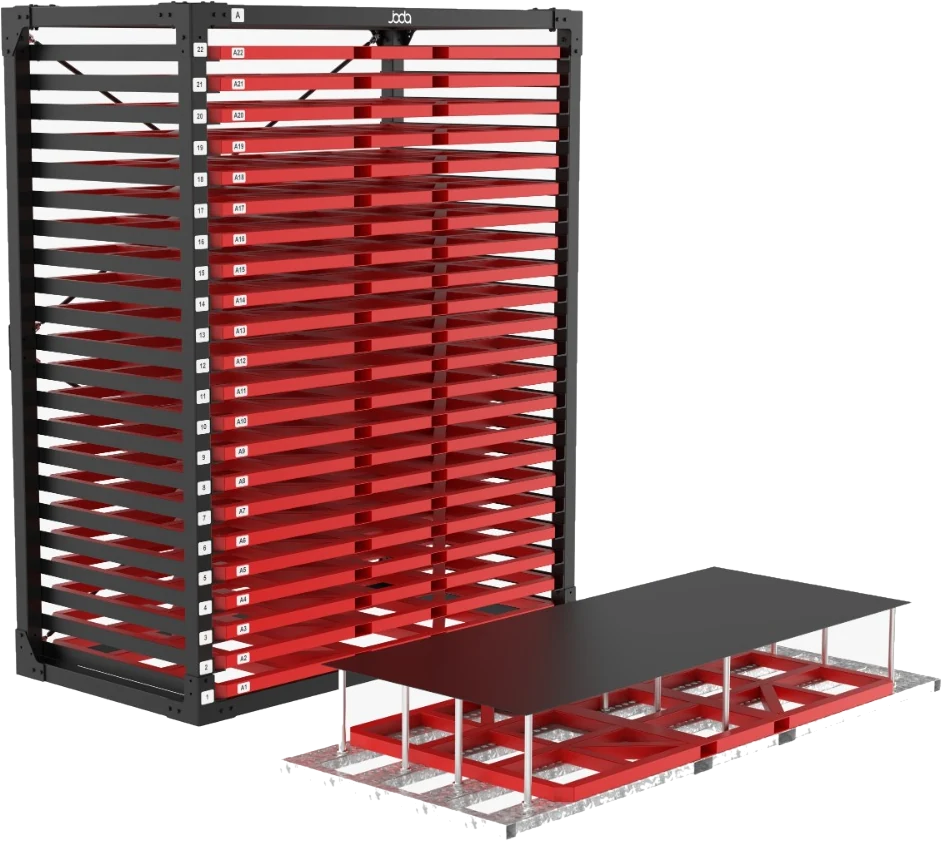
The delivery comes off its wooden pallet at the D-PALL and onto a steel one. That is the last time anything is lifted off the sheet.
The pallet slides into the rack and rests on welded angle brackets. Nothing is stacked on it and nothing sits on the sheet.
Draw the pallet out whole, take what the job needs, put it back. Nothing above it is disturbed to get at it.
The sheet goes from its slot to the laser without another stack in between — the same sheet you signed for.
Every failure at the top of this page came from the same two things: a fork touching the material, or something resting on it. Take both away and they go with it.
| Problem | How the steel pallet deals with it |
|---|---|
| Fork scratches | Tubes completely enclose the forks, so a driving or lifting error never reaches the sheet. |
| Flared edges | Reinforced tube edges hold the material safe even when forks come in slightly tilted. |
| Bent corners | A 3″ steel border runs around all four sides — knock the pallet and the material stays inside it. |
| Creased material | Welded angle brackets carry every pallet above. Nothing rests on the sheet; it stays clear inside the frame. |
| Rust | Nothing that holds moisture ever sits against the steel. |
These pallets slot straight into a P-RACK 510x22 storage system — full specification below.
04 — Sheet metal storage system
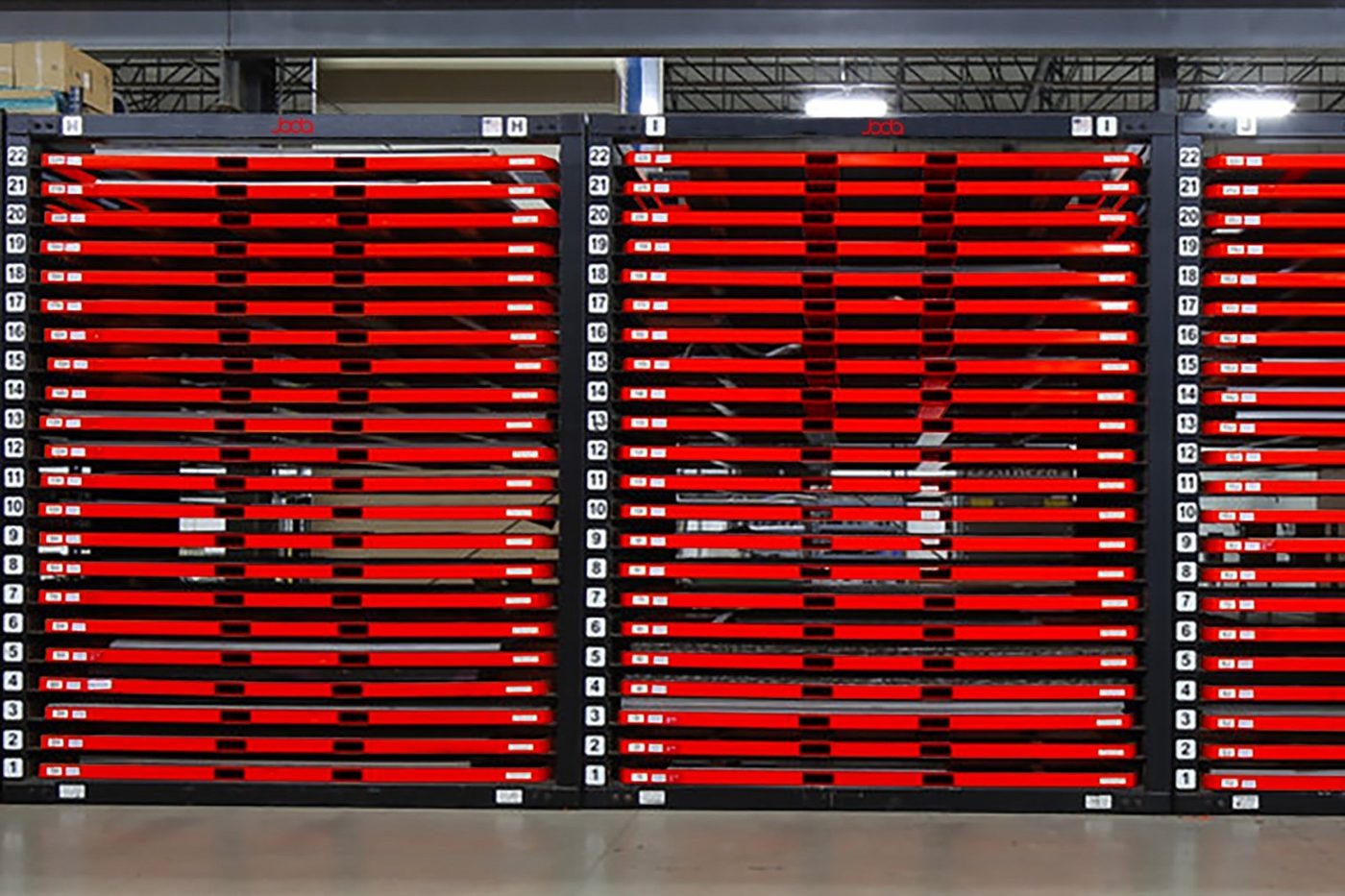
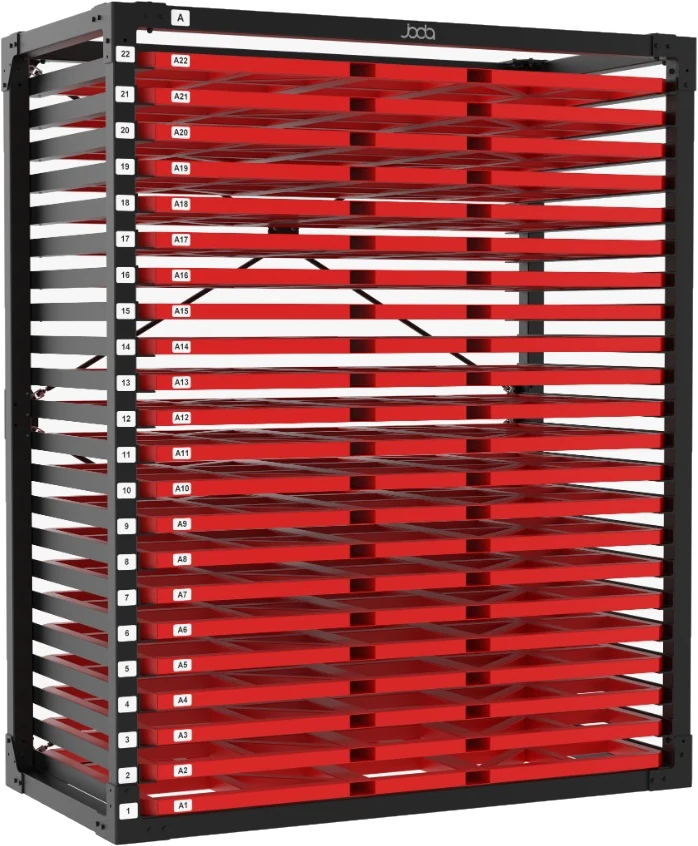
Twenty-two numbered slots per rack, engineered and stress-tested before it ships, so material stays as flat in week six as it was on day one. No pit, no control cabinet, no software licence — a forklift and a level floor is all it asks for.
| Specification | Metric | Imperial |
|---|---|---|
| Pallets per rack | 22 | 22 |
| Pallet length | 1,676mm | 66in |
| Pallet width | 3,200mm | 126in |
| Pallet max. load | 2,250kg | 5,000lb |
| Pallet-to-pallet gap | 102mm | 4in |
| Rack length | 2,032mm | 80in |
| Rack width | 3,556mm | 140in |
| Rack height | 4,220mm | 166.125in |
| Rack max. load payload | 49,500kg | 110,000lb |
The same rack in both unit systems. Rack max. load is the payload the pallets carry — 22 × 5,000 lb; the weight of the pallets themselves is carried in addition to it. All specifications are subject to change without notice.
Slots sit four inches apart, and about three of those inches are material. The last inch is working room: a pallet has to be lifted clear of its angles to go in and to come out, so it can't be posted into a gap that only just fits.
On a 4′×8′, three inches of mild steel comes to around 3,900 lb against a 5,000 lb pallet. Even copper — about the heaviest thing anyone puts in a rack — only reaches 4,500 lb. Fill that slot to the top with whatever you like and you are still inside the rating. On the larger footprints the rating arrives first: a 6′×12′ is at its 5,000 lb by an inch and three quarters of plate, with slot to spare. Work to the figure on the label, not to the space left.
A 7,500 lb pallet is available where the material warrants it. On a 5′×10′ it lets you use the full three inches — that much steel weighs about 6,100 lb, over a 5,000 lb pallet but comfortably inside a 7,500. The frame underneath is built heavier to carry it, with thicker sections through the rack, so pallet and rack are specified together.
Four inches is a compromise, and deliberately so. The same rack holds aluminium, brass, copper, mild steel, stainless, Hardox, alloys, titanium — better than three times the density range from the lightest to the heaviest. Cut the pitch down to suit plate and the aluminium loses half its slots; open it out to suit aluminium and the rack grows taller for nothing. Four inches earns its keep across the range, which is why we don't go under it. Where a plant runs one material and one thickness, we'll set the pitch to suit that instead — and agree the loading in writing before anything is built.
The rating on the label assumes the weight is spread across the pallet. Sheet does that by itself — it lies flat, edge to edge, and every part of the pallet takes a share. That is the load the 5,000 lb figure is written for.
Put the same weight in the middle instead and the pallet is doing a different job. Concentrated at the centre, the safe figure is 1,650 lb. Not half of the distributed rating — less than a third of it. A spread load is carried near the ends where the pallet is stiffest; a central load has the whole span working against it.
This matters because customers do it deliberately. Pull three to five pallets out, and the bay you open up will take a die, a coil, a crate, a fabricated assembly — and it is a sensible use of a rack that is already there. Just size it against the centre figure, not the one on the label. Tell us what you intend to put in the middle and we will work it before you load it.
First line of defence · A world first Patent pending
A rack this size can hold sixty tonnes of steel. If a forklift driver pushes a pallet too far in, something has to give — and it must not be the tower.
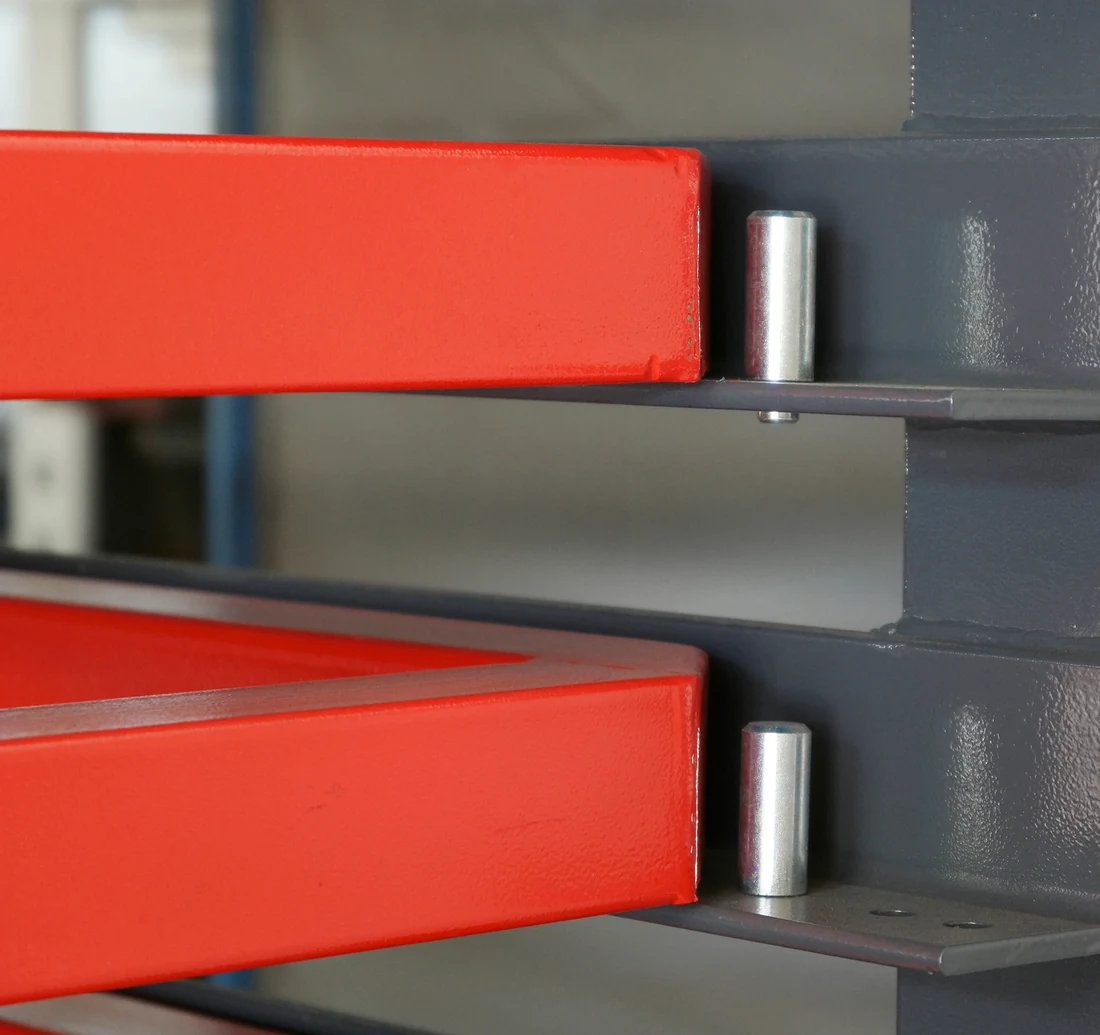
The industry answer is a steel tab welded to the back of the rack, sized to shear off before the unit goes over. It does the job, but it turns a driver's mistake into a fabrication job: cut it out, weld a new one in, repaint, and lose the rack while you do it.
We machine ours on a lathe instead. Every stop pin is turned to a calculated tolerance and simulated against the loads it will actually see:
The repair is one new pin, fitted by hand. No cutting, no welding, no paint, no rack out of service. We designed this ourselves and we were the first in the world to do it — because we spent years watching the industry fail at it.
Second line of defence Patent pending
Steel bracing runs corner to corner across the back of every rack, crossing at a central hub. Day to day it's what keeps a tall frame square: pallets moving in and out put a twisting load into the structure all shift long, the bracing takes it, so the uprights stay true and the slots stay parallel. That is a large part of why the sheets inside stay flat.
It is also the backstop behind the pin. If a driver pushes hard enough to release a stop pin, the load doesn't reach the tower — the bracing catches it:
Two separate stages have to be defeated before anything comes near tipping, and both are bolt-in parts you can hold in one hand. Anchored to the floor and cross-braced at the back, the frame holds its geometry with all 22 slots loaded.
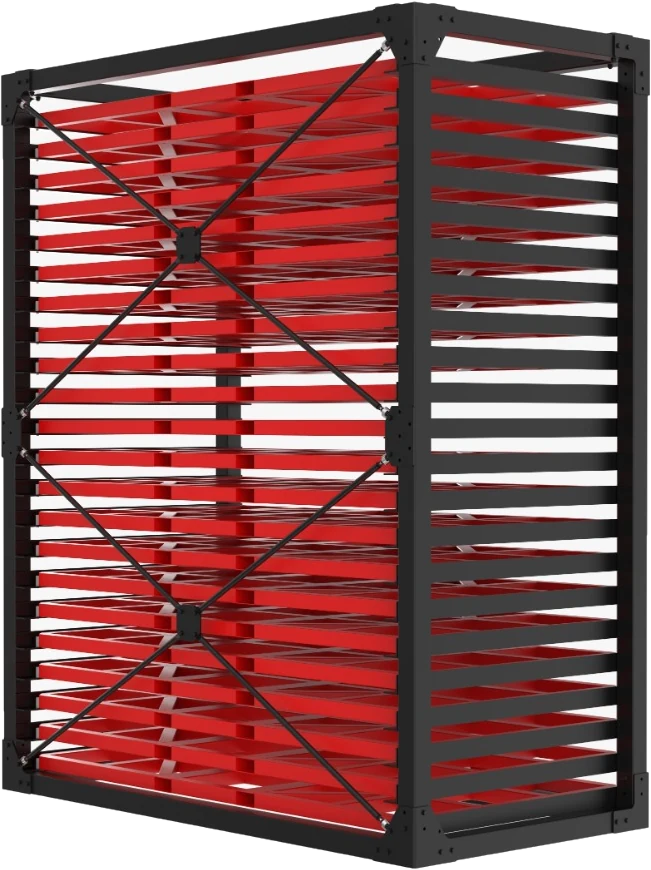
510x22 is one configuration. P-RACK is built to order across six pallet footprints and six tower heights — set yours below.
Figures are standard build options. If none of them suit your floor, we'll design one that does.
Racks arrive as a modular kit, fixings and instructions in the box. Two or three people, about three hours a rack.
Two things worth checking before delivery day. Headroom: 3–4 ft (0.9–1.2 m) above the finished rack. The constraint is the forklift mast rather than the rack itself, and it is the mast that finds the sprinkler line, the crane rail or the roof steel. Floor space: the rack’s own height in clear floor, plus about 5 ft (1.5 m) beyond it. The frames go up from flat, so one needs room to lie down before it is walked upright, and the crew needs somewhere to stand while it goes. Sweep the area back to bare concrete before anything comes off the lorry.
Yes — we strongly recommend anchoring every P-RACK and P-ROLL to the floor. Eight M16 × 150 mm steel sleeve anchors per rack. Stand the frames, mark through the base plates, drill, then set the anchors and tighten them before a single sheet goes on. That length is why the slab minimum is what it is: the anchor has to reach sound concrete, not just bite the surface.
Flat, sound, reinforced concrete — 6 in (150 mm) or thicker, C30/37 or better (about 4,350 psi). Level matters as much as depth: shim under the base plates until the frame stands true, rather than pulling it down into a hollow with the anchors.
Racks are drawn by our own engineers and put through load simulation before anything is cut, then proof loaded well past the rating they carry. Manufacturing runs under an ISO 9001 quality system. The calculation for your layout is done here, not left to the drawing.
The bottom six levels pull out like drawers. They run on the same pallets as the rest of the rack — a wheeled adapter turns a pallet into a drawer, so the lowest six roll out into the aisle instead of having to be lifted clear on forks.
Those are the levels a driver sees least of and reaches worst. Rolled out, the sheet sits in the open with nothing above it, so it can be lifted straight off rather than fished out from between two frames.
The drawer levels are fed from the back of the rack by forklift, which keeps the picking face clear. One rack, loaded from one side and worked from the other — drawer access at the bottom of the tower without moving to a powered system.
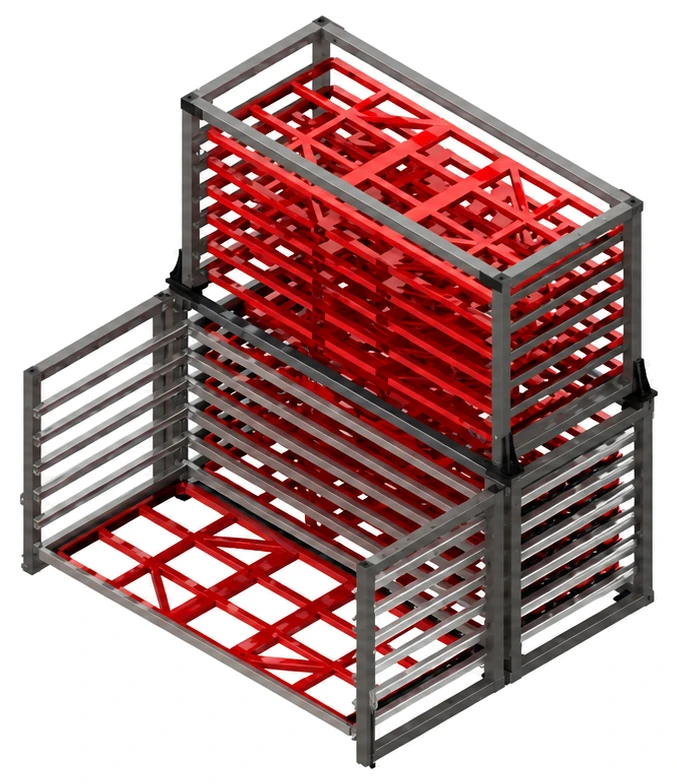
A travelling arm over the top of a P-ROLL. It runs left and right above the rack, lifts a sheet straight off an open drawer and sets it down on the machine bed. Stand the rack between two lasers and one P-ROLL feeds both.
Magnets or vacuum, whichever the material needs. Vacuum is what most lifters offer and it is fine on clean flat sheet — it struggles on perforated, on tread plate, and on hot-rolled still carrying its mill scale. A magnet takes all three without argument.
Hung from a hoist, or carried on a rigid mast. The hoist is the simpler build. The mast costs more and doesn't swing, so the sheet arrives where the operator put it instead of settling for a few seconds first — which adds up across a shift. Either way there is no forklift for the last few metres, nobody on the other end of the sheet, and the material goes from its slot to the bed without being stacked once in between. Fitted as an option.
05 — Loading & unloading
Material that arrives on timber gets moved onto our steel pallets at goods-in, before the moisture in the wood has a chance to mark it. D-PALL is the station where that transfer happens — and where you take material back off a pallet later.
The usual answer to this problem is to ask your steel supplier to palletise onto your pallets in the first place. If yours will, take it. Most won't, or won't for every grade and every order, and then you are back to lifting material off timber. D-PALL is for the way it actually arrives.
Adjustable forks
D-PALL is a set of adjustable forks. A steel pallet is an open frame, so it passes straight down through them. A sheet is solid — no holes — so it can't. It stays up on the forks.
That one difference is the whole station. Put material on the forks and it stays there; lift a pallet up through them and it takes the material with it. Nothing clamps the sheet, nothing grips it, and nobody slings a stack. The geometry does the work.
And because the forks adjust, one D-PALL covers every pallet size we build — 4'×8' through to 6'×12'. That is the real advantage of it: a plant running three different footprints still needs one station, not three.
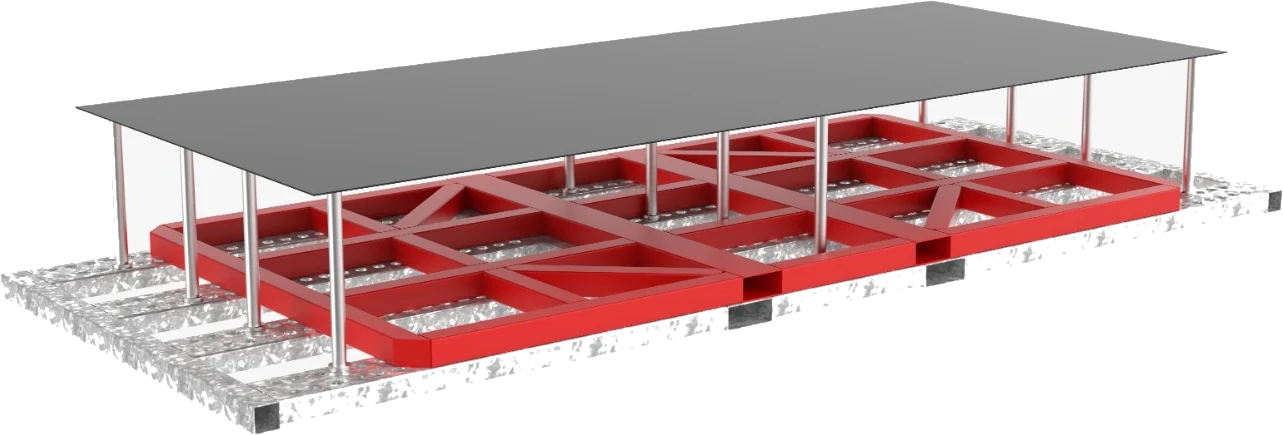
Loading — goods in. Set a steel pallet on the D-PALL so it drops through the forks, place the material on the forks, then lift the pallet back up through them — it collects the sheet on the way. Slide it into its numbered slot.
Unloading — picking. Bring the loaded pallet back to the D-PALL, take off the sheets you need, and return the pallet to the rack.
One forklift, one operator, no crane and no slings at any point in either direction.
06 — Bespoke design
Not every plant fits a catalogue. Tell us what you need to hold and show us the space you have, and we'll design the system around your building rather than ask you to work around ours — then build it.
Bespoke work is normal here, not an exception. Footprints, heights, slot spacing and D-PALL fork settings are all built to the job — the six standard sizes are simply the ones we're asked for most.
The rack can tell you what's in it. Sensors behind the slots report which are loaded and which are free. Lights on the face show the driver where the next load belongs, or which slot to draw out for the job in hand. RFID goes further: the pallet reports its own position, and since the material travels on the pallet, so does the material — what is in which slot stays on record without anyone writing anything down.
This is a bespoke build and it is priced as one. It earns its keep in a large store, where hunting for material is a real cost and a wrong slot is an expensive mistake. On a handful of racks a numbered grid and a clipboard will do the same job for nothing — and we will tell you so rather than sell you sensors you don't need.
07 — Getting started
Sheet sizes, gauges, volumes and where your material comes from. We'll come back with what a system would look like for your plant.
Jodauk Limited
7G Crichton Street
Dundee DD1 3AP
United Kingdom